Haldane Society AGM: Tuesday 24 February 2026

The Annual General Meeting of the Haldane Society of Socialist Lawyers will take place on Tuesday 24 February 2026 from 6:30pm, in person at Pelican House (Common Room), Bethnal Green, and online via Zoom. Attendance in person is encouraged where possible.

This is a members-only AGM. Please ensure your Haldane membership is active before attending. If your membership has lapsed, or if you would like to join for the first time, please visit haldane.org/join in advance.

Programme:

  • 6:30pm – Guest talk and Q&A: Fahad Ansari (Riverway Law)

  • 7:15pm – AGM business

The Zoom link and AGM papers will be sent to members the day before.

Get involved:

Members are warmly encouraged to consider standing for election to the Executive Committee. If you are interested in becoming actively involved, please email secretary@haldane.org. Members are also welcome to submit political motions for discussion at the AGM.

Statement by ELDH on the USA’s Illegal Act of Aggression Against Venezuela

We draw attention to the statement published by our affiliate organisation, European Association of Lawyers for Democracy & World Human Rights (ELDH), condemning the illegal act of aggression by the United States against the Bolivarian Republic of Venezuela.

The statement sets out in detail the legal basis on which the United States’ actions constitute a violation of international law, undermine the international legal order, and pose a serious threat to international peace and security.

You can read the full statement here:

ELDH Statement on the Illegal Act of Aggression by the United States Against the Bolivarian Republic of Venezuela (PDF)

ELDH states:

“We strongly and unequivocally condemn the acts of aggression carried out by the United States against the Bolivarian Republic of Venezuela. These actions constitute a grave and flagrant violation of international law, undermine the international legal order, and pose a serious threat to international peace and security…

We call upon European States and the institutions of the European Union to publicly and unequivocally denounce these acts of aggression, reaffirm their commitment to the UN Charter and international law, and refrain from any action that may contribute to or legitimize unlawful uses of force.

We further urge Member States to request an urgent meeting of the United Nations Security Council to address this situation, to demand the immediate release of President Nicolás Maduro and his wife, and to take all necessary measures, in accordance with the Charter, to uphold international peace and security and ensure accountability for violations of international law.”

Statement from our President, Michael Mansfield KC, on hunger strikers in custody

The Haldane Society of Socialist Lawyers continues to express its grave concern at the situation facing hunger strikers currently held in custody.

We are grateful to our President, Michael Mansfield KC, for setting out the wider legal, humanitarian and constitutional context in which this protest has arisen, and for his assessment of the treatment of those involved.

Michael Mansfield KC states:

“A central and crucial point of the hunger strike protest in custody is about the custody itself. It arises in the context of a completely broken criminal justice system in which the prison population of 80,000 is at capacity with insufficient staff and accommodation; and a system of trial which is stacking a backlog of 18,000, entailing a wait of two or more years: equivalent to a four or five year sentence.

Without more this destroys two basic principles: the presumption of innocence and the right to a fair trial process. Waiting for endless months in constrained circumstances is in itself unbearable, even for those waiting on bail. Often 23-hour-a-day lock-ups.

But for the hunger strikers it is far worse. That’s why they have had to take the only route that is left. They are treated as if they are convicted terrorists of the most heinous kind. Their means of communication by phone call or mail are monitored and scrutinised so severely that they are denied, stopped or curtailed - on grounds of national security - because ‘of course’ they are ‘guilty’ of obstructing government from contributing to massive damage against civilian populations in breach of all the rules of international criminal law you can imagine.

The same rationale is applied to restricted visits by family members and to ‘non-association’ orders which have resulted in solitary confinement. This is the enactment of the famous Carroll comment on the UK system of criminal justice from the mouth of the Queen of Hearts: ‘Sentence first; verdict after.’

It is hardly surprising that independent medical opinion finds the degree of appropriate management and critical care sorely lacking for these cases, many of whom are at risk of death on any of the days leading up to Christmas.

Despite repeated pleas, Government - especially Lammy and Timson - have either ignored or refused even the bare minimum of a meeting. A meeting accords with Government policy and protocol frameworks concerning prison safety. Essentially, they recommend an early review aimed at bringing about a resolution by a number of obviously interested parties, including representatives of the prisoner.

The initial basis for refusal was straight out of populist dogma: to even speak to these innocents would be a sign of weakness, and anyway it might open the floodgates for all prisoners. The idea that the mainstream prison population would be incentivised to risk death in order to improve prison conditions or achieve bail is to them utterly perverse and without any foundation.

Talking is hardly going to elevate, or in some way unfairly favour, these young conscientious individuals. It’s the other way round. Talking might end the discrimination and, for a change, provide those who are detained a fair hearing - another threatened principle - equality of arms.

It’s on a par with the calamity of Lammy’s reasoning for drastic cuts to jury trial; perverse and without evidential foundation.

But then one of the unspoken benefits for government, should the cuts be carried out, is precisely these cases. Many of the public order, protest and criminal damage cases will still be waiting years for trial (it’s not the jury causing the backlog) but will no longer be tried by juries, which have a ‘nasty’ tendency to acquit. Much more efficient to leave it to a single judge, many of whom have already displayed real antipathy to the issues relating to the ECHR and proportionality, duress of circumstances and necessity, in the firm belief that convictions will ensue.

We need to treasure the legacy of Messrs Bushel and Lilburne – hence the campaign to defend our juries.

May the strikers be part of that tradition and live to achieve the justice they seek.”

Message from our Vice President, Lord John Hendy KC, following the passage of the Employment Rights Act

The Haldane Society of Socialist Lawyers notes the passing of the Employment Rights Act, following Royal Assent, and commends the work of our Vice President, Lord John Hendy KC, who played a leading role in its development.

As a long-standing advocate for workers’ rights and collective labour protections, John’s contribution has been instrumental in shaping the legislation and advancing the wider debate on employment law reform and the rights of trade unions.

Commenting on the significance and limitations of the Act, John Hendy states:

“There is no doubt that the new Act will benefit many workers. And the repeal of the Strikes (Minimum Service Levels) Act and most of the Trade Union Act 2016 is a real step forward.

But the Bill is only a shadow of Labour’s original plan set out in A New Deal for Working People. In particular, the failure to address a single legal status for workers will only encourage employers to seek to recategorise workers to avoid giving them the new (and existing) rights.

The Act also missed the opportunity to enact a statutory process for sectoral collective bargaining across the economy. And the New Deal demanded that industrial action law conformed to the international obligations ratified by and binding on the UK. The Act does not do that.

Furthermore, the Act largely relies on individual litigation for enforcement but the average wait for a tribunal hearing is just under one year, awards are generally low and one third are never paid.

A second Act will be needed to finish the job.”

The Haldane Society recognises the passage of the Act as a practical step forward for working people, while reaffirming the need for continued legal and political work to secure a genuinely transformative framework for labour rights in the UK.

Statement on hunger strikes

The Haldane Society of Socialist Lawyers calls for Justice Secretary David Lammy to meet immediately with representatives of the prisoners on hunger strike awaiting trial on charges connected with direct action protest against arms sale to Israel.

Some of the strikers have been refusing food for over a month and a half and are at imminent risk of death. As of today, 18 December 2025, Qesser Zuhrar and Amu Gib (aka Amy Gardiner-Gibson) are on day 47 of hunger strike; Heba Mueasi is on day 46. In the 1981 IRA hunger strikes, Martin Hurson died on his 46th day without food. Yesterday Qesser Zuhrar became at least the sixth hunger striker to be hospitalised, following reports that she is unable to stand. Calls from protestors outside the prison, first for medical care and subsequently for an ambulance, were ignored for over 14 hours.

Legal representatives of the hunger strikers wrote to David Lammy on 10 December 2025 requesting an urgent meeting about the safety of the detainees, warning of a risk of irreversible harm to health. They have received no response to date. Lammy has also ignored interventions from MPs including John McDonnell and Zarah Sultana. Calls for Justice Minister Jake Richards to meet with the families of the strikers were met with laughter in the House of Commons. 

By the time the strikers stand trial - in some cases in 2027 - they will all have been held in custody for over a year, well in excess of the legal maximum custody time limit of six months. All the strikers have been refused bail. The strike is a response to the weaponisation of counterterror law - including proscription - and the prison system to clamp down on the right to protest and take direct action against a genocide. 

The strikers’ primary demands are: 

  1. End all censorship of their communications inside prison;

  2. Immediate release on bail;

  3. Ensure their right to a fair trial through disclosure of all relevant documentation relating to their cases; 

  4. De-proscribe Palestine Action and end the Prevent strategy;

  5. Shut down all UK sites of Elbit Systems Ltd, Israel’s largest weapons manufacturer.

The Haldane Society urgently calls for David Lammy to meet with Qesser Zuhrah, Amu Gib, Heba Muraisi, Teuta Hoxha, Kamran Ahmed and/or their representatives before any of those on strike lose their lives. If he fails to do so, their deaths and any ensuing civil unrest will be on his hands.

Further information and updates about the strikes can be found on their website: https://prisonersforpalestine.org/ 

Statement on trial of humanitarian workers in Lesvos

On Thursday 4 December 2025, 24 humanitarian workers began a 20 day trial in Lesvos as a result of work they carried out in 2018 to rescue shipwrecked migrants. The majority of the co-accused have lived experience of irregular migration. They face criminal charges including “people smuggling,” “money laundering” and “membership of a criminal organisation”. The charges of people smuggling relate to work searching for and rescuing adults and children in peril at sea. The charges of money laundering relate to a web page raising money for the essential living needs of destitute people on the island.

 If found guilty they could face up to 20 years in prison.

Among the 24 is Seán Binder who grew up in Ireland, but studied, was called to the Bar, and completed a criminal pupillage in London. Seán is one of our community of lawyers.

In 2018, after finishing his undergraduate degree at the London School of Economics, Seán travelled to Lesvos to volunteer with a Greek NGO, Emergency Response Center International (ERCI). He and his co-volunteer Sara Mardini were arrested while scanning the sea for shipwrecks.  They were released before later being re-arrested, charged and held in pre-trial detention for 106 days.

International human rights groups have called on the Greek authorities to drop the charges as they are unsupported by the evidence and are an abuse of process. We extend solidarity to Seán our colleague and to his co-accused and we support the calls to drop the charges.

Addendum: the trial has been adjourned (again) to January 2026

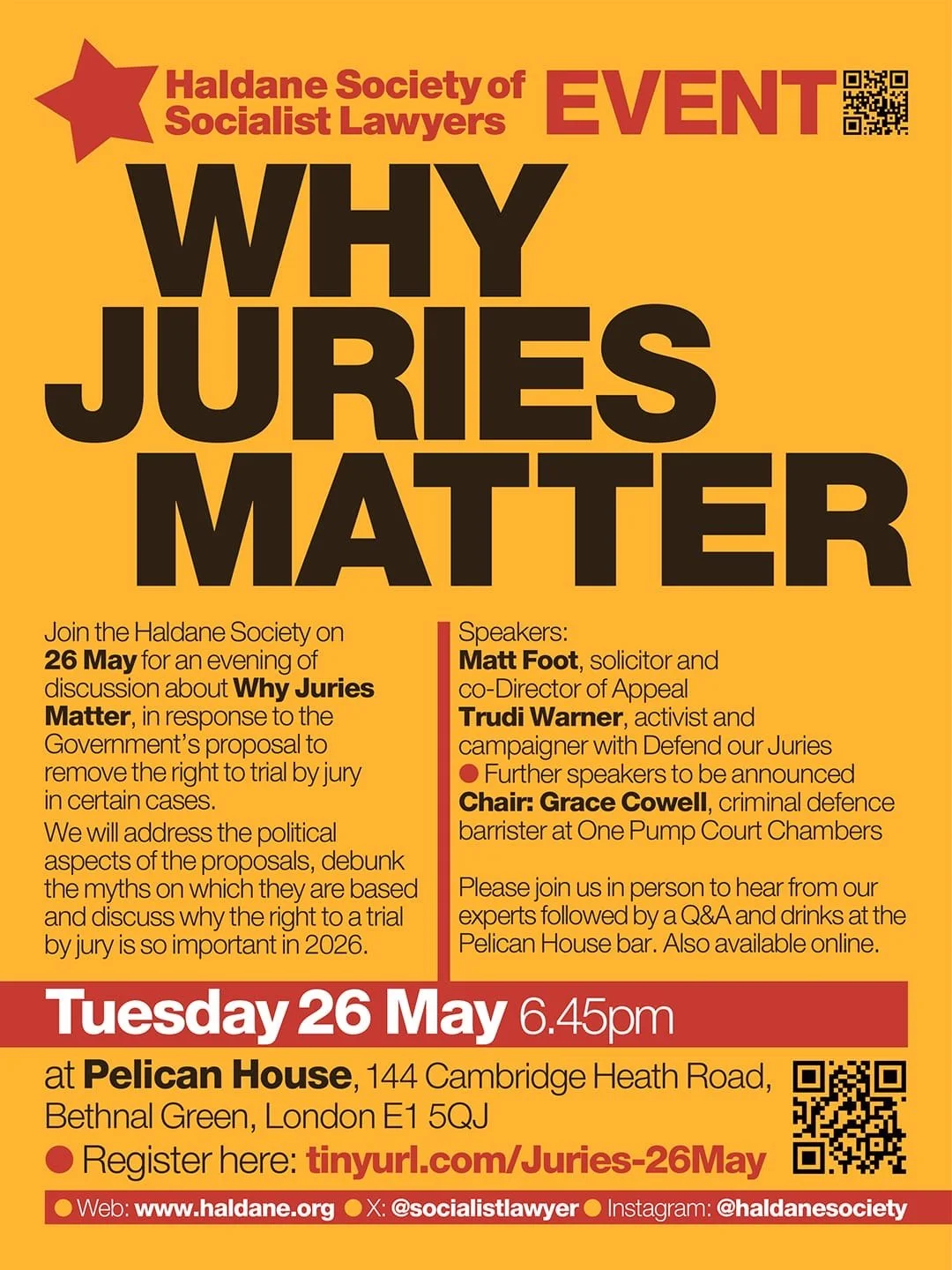
Statement on government proposals to restrict access to jury trials

“The right to trial by jury is an important factor in the delicate balance between the power of the state and the freedom of the individual. The further it is restricted, the greater the imbalance. Despite the inevitable increase in costs, the Haldane Society urges that there be a right of trial by jury in all criminal cases.” - Keir Starmer, Socialist Lawyer, Spring 1992.

The Haldane Society of Socialist Lawyers opposes the Government’s new proposal to remove the right to jury trial for certain cases. Two things are clear: the proposal would further erode the rights of the individual in an increasingly authoritarian society with an increasingly punitive state, and there is very little evidence that it would achieve the stated aims.  

The Haldane Society remains of the view – unlike our hypocrite Prime Minister who has time and again betrayed his younger self – that the jury system is a bulwark against the might of the State. The reasons why it is infinitely preferable to trial by judge alone are well rehearsed but no less compelling for that. The judicial class is no substitute for the diversity of experience of 12 of one’s peers.  Juries are also free from the ‘seen-it-all-before' cynicism that can infect magistrates and professional judges. This Prime Minister should know that better than anyone. It should be a matter of shame that under his Government protesters are increasingly criminalised; migrants demonised; and now the right to trial by jury imperilled. We call on our colleagues across the criminal Bar to resist these plans.

The criminal justice system suffered some of the deepest cuts of the austerity years which saw dozens of court closures and hundreds of lost sitting days. The real cause of the Crown Court backlog is the failure of successive Governments to adequately resource the so-called justice system, coupled with an ever-expanding repertoire of statutory offences which lead people to be dragged through the system.

The removal of the right to trial by jury will not remedy the backlog. It will not stop Serco from consistently failing to meet the terms of its government contract. It will not prevent court roofs from collapsing and courtrooms sitting empty while the government refuses to pay for adequate sitting days. It will not stop cases from being unable to go ahead due to the inability to find a barrister to prosecute or defend it, due to the drastic retention problems experienced by the criminal Bar.  

These proposals can and must be stopped and we will work with colleagues across the criminal justice sector in defeating these plans.

In Memoriam: Sir Geoffrey Bindman KC (Hon) 1933–2025

It is with profound sadness that we mark the passing of our Vice President, Sir Geoffrey Bindman KC (Hon), who died on 5 November 2025 at the age of 92.

Much will no doubt be written about this man’s exceptional career in the coming weeks, and there is little we can add here except to say that he was a titan of human rights law, an inspiration to so many in our Society and one who will be deeply missed by the profession.

We extend our most sincere condolences to his family. His legacy will endure.

Rest in power, Geoffrey.

Haldane statement on recognition of the State of Palestine

The Haldane Society calls upon the UK government to immediately recognise the State of Palestine. Having correctly described statehood as the ‘inalienable right of the Palestinian People’, the UK government must not make recognition dependent on the fulfilment of any conditions, in line with its obligations under the UN Charter and other sources of international law.

Background

The Prime Minister has stated that the UK will recognise the state of Palestine by the United Nations General Assembly in September, subject to steps to be taken by the Israeli government and potentially also by Hamas. The Israeli government is called to take substantive steps to improve the situation in Gaza, including restarting the supply of aid, agreeing to a ceasefire, and committing to reviving the prospect of a two state solution. Meanwhile, he demands that Hamas release remaining hostages, commit to a ceasefire, disarm, and accept that they will play no part in the government of Gaza.

Unconditional recognition of the State of Palestine

While recognition of Palestinian statehood is long overdue, international law does not permit the UK to make such recognition contingent on the fulfilment of conditions.

All peoples have the right to self-determination (Article 1, ICCPR). Since 1974, the UN General Assembly has explicitly recognised the Palestinian right to self-determination “without interference” (UNGA Resolution 3236 (XXIX)). This Palestinian right has been affirmed on more than one occasion by the International Court of Justice since 2004 (p. 183, para. 118).

A corollary of the right to self-determination is, amongst other things, the right of the Palestinian people “ to determine their political status” (Article 1, ICCPR). The “establishment of a sovereign and independent State” constitutes a mode “of implementing the right of self-determination by that people” (UNGA Resolution 2625 (XXV), p. 124).

As a member of the United Nations, the UK has an obligation to respect “the principle of equal rights and self-determination of peoples” (UN Charter, Article 1(2)). Moreover, the UK has “the duty to promote, through joint and separate action, realization of the principle of equal rights and self-determination of peoples” (UNGA Resolution 2625 (XXV), p. 123-4).

Consequently, refusal by the UK to recognise the Palestinian right to a state, on the basis of any condition, is contrary to its obligations to respect and promote the right of the Palestinian people to self-determination.

The Haldane Society, standing in solidarity with the Palestinian people and their struggle for liberation, unequivocally affirms their right to self-determination and calls for the British government to unconditionally recognise the state of Palestine.

Statement in solidarity with the trans community 

Haldane stands in solidarity with the trans community in the face of the recent Supreme Court judgment in For Women Scotland Ltd (Appellant) v The Scottish Ministers (Respondent) [2025] UKSC 16.  

The ramifications of that judgment have become increasingly apparent through heightened levels of abuse and transphobia, and the ensuing negative impact upon safe access to public spaces for trans people. Haldane notes and joins the concerns raised by many about the interim guidance on trans rights produced on behalf of the Equality and Human Rights Commission (‘EHRC’) – guidance which clearly goes beyond even this devastating ruling - and supports the wide-ranging calls for the consultation period on the EHRC guidance to be thorough and detailed, allowing affected parties to be fully and comprehensively heard. The inclusion of trans people within that process is particularly vital given the fact that no trans-affiliated groups were heard within the Supreme Court hearing, nor was significant consideration given to the impact upon intersex individuals.  

Any final guidance should be workable and enable full access to society for all trans, non-binary and gender-diverse people, who it is recognised suffer significant and increasing levels of misogyny, transphobia and violence. 

Haldane is mindful of the decision in Goodwin v UK (2002) 35 EHRR 18, in which the European Court of Human Rights (‘ECtHR’) held that the U.K. had breached its positive obligation under Article 8 to ensure respect for private life by failing to give legal recognition to the applicant’s gender reassignment, as well as under Article 12. This decision led to the enactment of the Gender Recognition Act (‘GRA’) 2004. In addition to the wider ramifications of the Supreme Court judgment in For Women Scotland Ltd, Haldane has been particularly concerned about another recent legal attack on trans people - namely an attempted amendment to the Data (Use and Access) Bill which would have allowed data protection rules to be rewritten to force public authorities to collect ‘sex at birth’ data from members of the public1 and which would watered down the provisions within the GRA 2004, as well as representing a rollback of rights for transgender, non-binary and intersex people.  

Haldane robustly supports the concerns raised by multiple organisations about the undermining of protections within the GRA 2004 and the likelihood that the judgment in For Women Scotland Ltd will continue to be used to stoke the ‘culture war’ being waged against trans people across the U.K.